

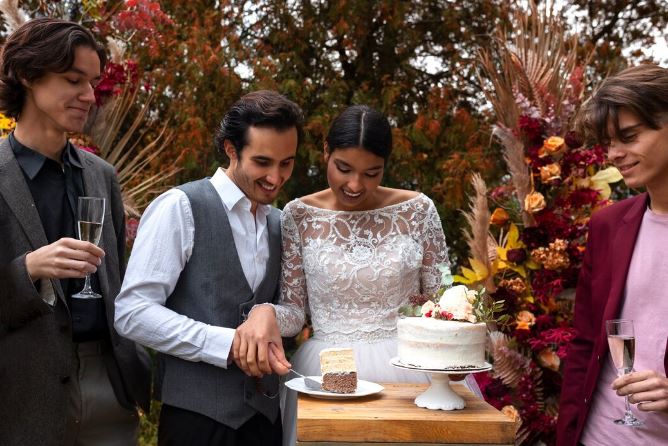
I had low expectations going into the garden wedding, particularly with regard to the cuisine. With its watercolor leaves, pressed-paper texture, and suggestion of simplicity rather than luxury, the invitation had been charming in a subtle way. I thought the meal would be pleasant, seasonal, and forgettable, as garden weddings typically promise atmosphere over substance.
| Context | Details |
|---|---|
| Event type | Outdoor garden wedding |
| Season | Late spring |
| Service style | Family-style with interactive elements |
| Common expectation | Rustic, simple, or secondary food |
| Key shift | Food treated as central experience, not background |
The ceremony was held shortly before five o’clock, when the air had not yet cooled and there was still plenty of light. The grass was strewn with folding chairs, and the breeze snagged the vows just enough to make them seem genuine. All of this implied moderation, an event meant to avoid going too far.
Cocktail hour started right away, which already seemed like a minor but significant choice. After the swift appearance of drinks, trays of unimpressive food arrived. What was being served was not announced. People just ate by reaching out.
The temperature was the first thing I noticed. In the open air, everything made sense. It was cool where it needed to be and warm where it should have been. Nothing opposed the environment. The flavors were bold and straightforward: garlic that hadn’t been subdued for safety, herbs that tasted alive, and acid where you wanted it.
Midway through the story, a nearby woman stopped to inquire about the origin of the flatbread. Another person completely stopped listening and followed the response. The food lacked aesthetic appeal. It required notice.
Dinner came up without warning. Without place cards, the long wooden tables gradually filled up, but they had enough structure to prevent the room from becoming disorganized. They brought big platters and bowls, the kind that take two hands and a quick haggle with strangers.
As a visual concept, this was not family-style dining. It was unreserved and giving. I observed a man in a navy suit mopping bread with sauce, halting, recognizing his mistake, and grinning at himself.
The salads arrived late, which seemed intentional. They weren’t a pause or a duty. They were significant enough. Nobody objected when someone remarked, quite casually, that they had never eaten this well at a wedding before.
The meal’s tempo changed the atmosphere in the room. People continued to sit for longer. Discussions converged rather than dispersed. Everyone seemed to relax when kids ate the same food as adults, without any explanations or changes.
Halfway through the second course, I noticed that nobody in my immediate vicinity had looked at their phone.
In contrast to flowers and lighting, the food served as an attention-getter. It demanded to be there. A server once noticed that a nearly empty bowl was getting low and refilled it without asking. Instead of being intrusive, it felt perceptive.
Garden weddings are frequently organized around unforeseen circumstances, such as heat, insects, scheduling, and the worry that something might go wrong. This one seemed to be planned around potential success. The evening’s logic became evident when someone casually mentioned that the couple had decided on the menu before selecting the flowers.
Dessert didn’t show up all at once. It happened. First came fruit tarts, then little glasses of something citrusy and cold. The cake arrived already cut, saving everyone the customary waiting period. Forks in hand, people moved between tables as conversations organically resumed.
The way the food granted permission was what really caught my attention. to stay. to wait a few seconds. to have their mouths full while speaking. Dinner had done the trick, so there was no late-night snack reveal.
No one hurried to the dance floor as the music gradually began to play. They didn’t have to get out of their seats. When the dancing did start, it didn’t feel like a start over, but rather a continuation.
I realized that I had underestimated the potential of outdoor wedding cuisine.
Even though the garden was lovely, its memory faded a little. It was the meal that people discussed, honestly, without lowering their voices. A sauce recipe was requested. Another person inquired if there were any leftovers.
The couple was not in a rush and moved through the tables with ease. Clearly, they had eaten. Proper feeding brings about a certain calm, and it was evident.
The atmosphere was already set when the sun went down and the air cooled. It was the meal that refused to be a background detail, not the scene.
My mental category for “garden wedding food” had subtly fallen apart as I was driving home. What I thought was a restriction was actually a decision.
Every civilly endured wedding dinner I could recall felt suddenly negotiable as a result.
