

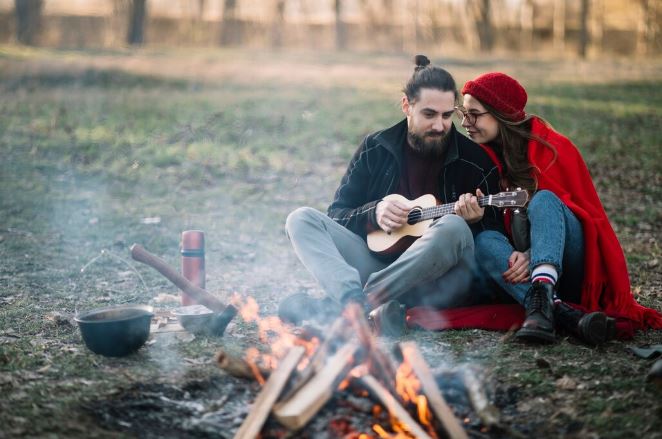
Before the food is served, there is a brief period of time when everyone stops talking and just watches the fire.
It’s difficult to ignore how different that quiet is from the quiet of a fine dining establishment. Silence in a Michelin-starred restaurant can be courteous, even a little tense, as if everyone is waiting for the next course to be served with the accuracy of a stage cue. The quiet is softer around a fire. The wood fractures. Someone moves their seat. A hand instinctively tests the heat by hovering over it.
Perhaps this is where the romance starts—not with the food itself, but with the anticipation.
Despite its brilliance, fine dining tends to detach the diner from the creative process. The finished plates are symmetrical and nearly flawless. It can be impressive, even theatrical, to watch a server go into great detail about a dish. However, you also feel as though a decision has already been made for you. The experience is carefully planned, managed, and occasionally a bit detached.
| Category | Details |
|---|---|
| Topic | Open-Fire Cooking vs Fine Dining |
| Key Figure | Bart Van Der Lee |
| Industry | Culinary Arts / Hospitality |
| Trend Insight | Rise of wood-fired cooking in Nordic and global restaurants |
| Notable Example | Ekstedt |
| Cultural Source | Falstaff |
| Reference Link | https://www.falstaff.com |
In contrast, cooking over an open flame feels incomplete until the very end. Flames change. Unpredictably, smoke drifts. Someone flips a piece of meat a bit too soon or modifies the grill height. It’s disorganized. And instead of turning people away, that messiness seems to draw them in.
Stories about cooking over a fire evoke memories of someone tending embers late into the night, people getting closer as the air cools, and conversations going longer than expected. It doesn’t seem planned. It takes place.
This has also been observed by chefs. Bart Van Der Lee once said that cooking over a fire “brings ingredients to life,” but he seemed to be implying—possibly inadvertently—that it also brings people to life. Seeing someone plate a dish under bright kitchen lights is not the same as watching them cook over an open flame. It feels like a craft. The other seems ritualistic.
Additionally, rituals often have emotional significance.
Time is another issue. To keep guests’ attention, fine dining frequently condenses time into courses—small, purposeful portions that arrive at regular intervals. In its own way, it is effective. Cooking over an open flame defies that framework. Food requires patience as it cooks slowly and occasionally unevenly. Individuals come and go from conversations. Another drink is poured by someone. Another person pokes at the fire.
The meal turns into a shared period of time rather than a series.
It’s still unclear if people genuinely prefer this slower pace or if it just seems uncommon in a world where speed is the norm. However, there is a growing movement that indicates something more profound is taking place, particularly in regions like Scandinavia. Restaurants such as Ekstedt have built their entire reputations on cooking without electricity, using wood-fired methods that seem almost unyieldingly antiquated.
The lack of convenience doesn’t seem to bother diners, which is interesting. They lean into it, if anything.
Maybe because fire has a subtle effect on how people behave. For a long time, anthropologists have proposed that congregating around fire taps into an ancient, pre-verbal energy. A feeling of security and even fascination is present. People gaze at flames for longer than they mean to. Without effort, conversations become more in-depth.
On the other hand, fine dining frequently promotes a certain kind of performance. People take care with their attire. They use somewhat subdued tones when speaking. A sense of being observed is present. That awareness wanes around a fire. Hands become unclean. People start laughing more loudly. Someone will inevitably burn a piece of bread and dismiss it.
It seems more forgiving.
Flavor is another issue, but it’s hardly as important as the experience. Smoke has scents that are difficult to duplicate in controlled kitchens. Short bursts of aroma are produced when fat drips onto coals and rises back into the food. Yes, the outcome is richer, but it’s also more uncertain. Additionally, in moderation, unpredictability can be thrilling.
However, it would be too simple to completely discount fine dining. It is unquestionably artistic. Precision is beautiful in its own right. Observing a flawlessly prepared dish reach the table can be like witnessing a tiny demonstration of mastery and discipline.
However, it appears that discipline isn’t always followed by romance.
It comes after warmth. It adheres to flaws. Moments that don’t quite go as planned are followed.
People seem to remember meals prepared over fire in a different way, which is hard to prove but easy to sense. The setting is just as important as the flavor. light flickering across a person’s face. The following morning, clothing still smelled like wood. Time stretched, almost imperceptibly.
Excellence can be found in fine dining. That much is for sure.
Fire, however, provides an alternative. Something a little more in line with what people mean when they talk about romance, perhaps because it’s less polished and predictable.
