

The dinner bell no longer signifies what it once did on a summer evening at a rural estate—imagine gravel crunching beneath shiny shoes, a row of olive trees lit by gentle lanterns. It’s not always the case that guests line up for their designated seats. Rather, they float. A small plate here, a glass of champagne there, conversations starting to form in groups rather than rows.
Although this gradual change has been developing for years, it has recently become more apparent. According to reports from Vogue and industry planners, couples are reevaluating the ideal reception meal, particularly at upscale estate weddings where tradition used to take precedence over innovation. The traditional sit-down dinner, which consists of several courses, is timed precisely and frequently lasts for several hours, has not vanished. However, it no longer defines the evening in the same manner.
| Category | Details |
|---|---|
| Topic | Luxury Wedding Dining Trends |
| Industry Focus | High-end event planning & catering |
| Key Organizations | Vogue, Brides |
| Event Specialists | Caper & Berry |
| Trend Direction | Shift toward immersive, flexible, experience-led dining |
| References | Forbes, Los Angeles Times |
| Useful Links | https://www.vogue.com • https://www.brides.com • https://www.forbes.com |
This change has a useful aspect. The format of a meal shapes the entire rhythm of a wedding, according to insights highlighted by Brides. A plated dinner divides the evening into distinct sections by securing guests to their seats. That arrangement may seem sophisticated, even comforting. However, it can also make things take longer. Couples seem to be emphasizing movement at receptions these days, keeping the dance floor lively and allowing conversations to flow organically rather than according to predetermined seating charts.
It’s not exactly chaos that is taking the place of that structure. It’s less strict but more carefully chosen. Immersion dining formats, such as longer cocktail receptions, food stations, and what some planners refer to as “floating suppers,” are becoming more popular, according to upscale caterers like Caper & Berry. Visitors move between areas that resemble separate restaurant rooms, each with a unique taste or atmosphere. The meal becomes more of an ongoing presence throughout the evening rather than a major event.
It’s difficult to ignore how much this reflects more general shifts in dining culture. High-end eateries themselves have been embracing shared plates, open kitchens, and food-related storytelling in place of rigid formality. Weddings appear to be following suit in that regard, especially those held on expansive estates with numerous terraces and gardens. The experience is more like passing through a sequence of carefully chosen moments than it is like going to a banquet.
This change has an emotional component as well. According to the Los Angeles Times, there is a growing trend toward “quiet luxury” weddings, where customs are subordinated to personal significance. In this context, food takes on the role of a narrative. A couple may recreate a meal from an early trip or serve dishes inspired by family history. A more adaptable, experience-driven approach naturally incorporates that type of personalization, but it is awkward in a rigid plated format.
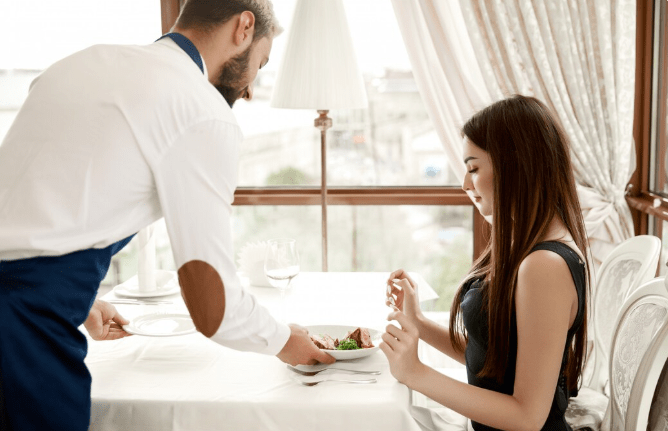
The shift isn’t complete, though. Formal dining is still relevant and, in some cases, even resurgent, according to many planners. A well-executed seated dinner exudes confidence—linen is pressed, silverware is arranged, and servers move in almost silent unison. It marks an occasion. It implies that this is an important enough moment to stop. However, the specifics are changing even here. With dishes that feel more like restaurant offerings than traditional wedding fare, plated menus are becoming less predictable.
Perhaps the shift is more about redefining formality than it is about giving it up. Before switching to a shorter seated course, a wedding may start with an extended cocktail hour that serves passed canapés and small bites. Alternatively, it may provide communal tables and lounge areas in place of assigned seating. The evening feels less divided, and the lines become hazy.
Reactions from the general public indicate that visitors are reacting to this flexibility. It appears that having the freedom to move around and decide what and when to eat produces a different kind of energy. Discussions overlap. Groups come and go. It feels more like a get-together than a performance. However, there is still an unanswered question regarding balance. Some visitors, especially elderly relatives, might feel lost in the absence of structure. There is still some tension.
Logistics and cost also come into play, though not always in clear ways. Luxurious estate weddings come with complicated layouts, including several outdoor spaces, historic buildings, and occasionally uneven terrain, even though they frequently have large budgets. Careful coordination between these areas is necessary for a fully seated dinner. Even though they are still complex, more flexible dining arrangements can more readily adjust to the surroundings, enabling planners to incorporate the estate into the experience.
It’s still unclear if this change will become the norm going forward or if it will just be one choice among several. The wedding business has always fluctuated between tradition and innovation. However, there is currently a discernible trend toward less scripted experiences.
As this develops, there’s a subtle feeling that something more profound is shifting. Weddings are no longer just about showcasing elegance, particularly at the luxury level. They’re starting to focus on how that elegance appears in motion, how visitors engage, and how events develop naturally. The formal dining table, which used to be the focal point of the scene, is gradually making way for something more flexible.
