

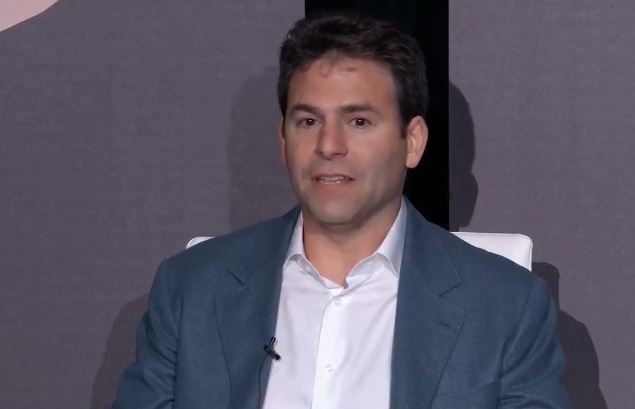
The story of how James Litinsky came to be in charge of the only rare earth mine in the US has an almost cinematic quality. He was not raised near refineries or drilling rigs. He was a Northwestern law and business graduate, a Yale economics student, and the type of guy who, as a teenager, reads Forbes and concludes that finance is the game. And yet here he is in 2026, sitting on a fortune that, depending on who you ask, ranges from $400 million to $1.4 billion, built primarily on a flooded pit in the Mojave Desert that hardly anyone else wanted.
Depending on the day, the numbers convey different narratives. In late April 2026, Quiver Quantitative estimated his net worth at about $1.4 billion based on his 21.7 million MP Materials shares. Around the same time, GuruFocus valued him at $861 million. In August 2025, Forbes declared him a new billionaire at $1.2 billion following a 150% increase in MP’s stock following the announcement of a Pentagon investment. The wide range is more a reflection of how sharply rare earth prices fluctuate and how much of his paper wealth depends on a single ticker than it is of careless reporting.
| Bio Data / Important Information | Details |
|---|---|
| Full Name | James H. Litinsky |
| Age | 47 (as of mid-2026) |
| Residence | Las Vegas, Nevada |
| Nationality | American |
| Education | B.A. Economics, Yale University (cum laude); J.D. & M.B.A., Northwestern University |
| Current Role | Founder, Chairman & CEO, MP Materials Corp. (NYSE: MP) |
| Previous Career | Founder & CEO, JHL Capital Group (2006–2023); Fortress Investment Group; Allen & Company |
| Estimated Net Worth (2026) | $400 million – $1.4 billion (varies by source) |
| MP Materials Stake | Approximately 21.7 million shares (~7–8% of the company) |
| Source of Wealth | Hedge fund returns + equity in MP Materials |
| Key Asset | Mountain Pass mine, San Bernardino County, California |
| Notable Deal (2025) | U.S. Department of Defense became the largest shareholder via a $400M preferred stock purchase |
| Bar Admission | Illinois |
The net worth figure is not what makes the story compelling. It’s the route. In 2014, JHL Capital Group, Litinsky’s hedge fund, invested roughly $20.5 million in Molycorp‘s distressed bonds. Soon after, Molycorp filed for bankruptcy. The majority of fund managers would have moved on, licked their wounds, and written it off. Instead, he took a plane to Mountain Pass, where he was captivated by the sight of a 600-foot pit that contained 30 million gallons of standing water. It’s the kind of choice that, in hindsight, seems romantic, but in the moment, it seems reckless.
The company’s numbers are impressive. MP has extracted 42 million tons of rock and processed it into about 207,000 tons of rare earth oxides since it resumed operations in 2018. The company raised $545 million when it went public in 2020 through a SPAC. The stock briefly reached $56 before China flooded the market with cheaper neodymium-praseodymium, causing shares to plummet to about $15. The U.S. Defense Department then declared in July 2025 that it would sign a ten-year magnet purchase agreement, purchase $400 million in preferred shares, and thereby become the company’s largest shareholder. A few days later, Apple invested $500 million. The stock increased by more than twofold.
Along the way, Litinsky has been selling steadily. According to SEC filings, there have been 33 insider transactions since 2021, including a sale of 3 million shares in August 2022 and more recent sales in April 2026. He still owns the majority of his position despite having cashed out about $636 million in stock. It looks like someone who remembers what it was like to almost lose $40 million on a junk bond.
Observing all of this, one gets the impression that Litinsky was fortunate in the way that contrarians occasionally do—that is, when geopolitics turns out to be in their favor at the perfect time. Approximately 80% of the world’s rare earths are still mined and refined in China. Washington has determined that’s an issue. The Pentagon’s direct equity stake, the Biden-era subsidies, and the tariffs imposed by the Trump administration have all worked to his advantage. It remains to be seen if that political windfall will last for the next ten years. The magnet plant in Fort Worth continues to ramp up. The margins are still narrow. The long thesis appears to be accepted by investors, but balance sheets and beliefs are two different things.
It’s difficult to ignore the fact that the man at the center of it all still doesn’t exactly fit the stereotype of a mining magnate. As a hedge fund manager who wound down his fund and went all in on rocks, he is a finance guy who picked up chemistry on the job. Perhaps the U.S. rare earth industry needed that outsider’s perspective.
