

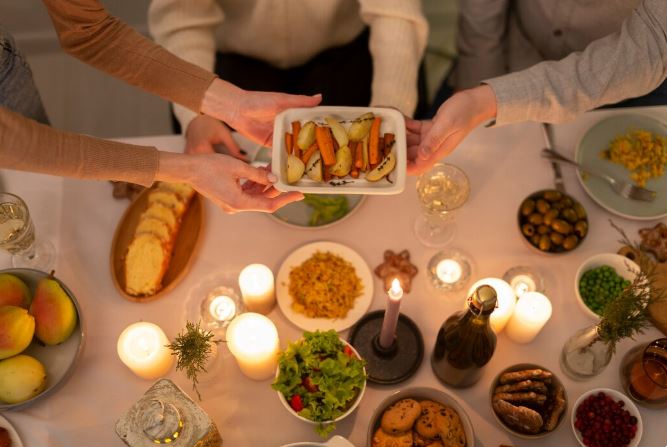
Everyone looks in the same direction during the ceremony at the majority of weddings.
It is during the meal that they finally exchange glances.
Usually, it starts off awkwardly. Chairs scuff. Napkins are unfolded and folded. Before wine arrives, people look around the table for hints about who they’ve been seated with and how long they’ll need to engage in small talk.
When bread is served, there is frequently a silent sense of relief. Bread is neutral. Bread doesn’t ask.
| Context | Details |
|---|---|
| Setting | Wedding receptions where guests often share tables with people they’ve never met |
| Typical dynamic | Initial politeness, low expectations, mild social guardedness |
| Key catalyst | Family-style dining, shared dishes, informal conversation prompts |
| Social shift | From parallel eating to collective participation |
| Result | Temporary but genuine bonds formed over food |
Usually, the first actual interaction is logistical. Who wants butter? The serving spoon is unnecessary. When someone reaches across someone else’s sleeve, they apologize. The couple’s names come next, followed by affiliations and the courteous abbreviation for how everyone knows them.
The majority of group dinners stall at this point. Individuals withdraw into their food. Pairs of people start talking. There are phones.
However, something changes at weddings where the food is meant to be passed.
Steaming and unworkable, a large platter arrives. Nobody can act as though it doesn’t exist. It must be lifted by someone. Someone else must assist. Portions must be decided, and all of a sudden, strangers are negotiating plenty together.
This small act has an intimacy to it. You discover a person’s dish-holding technique. if they are hesitant to serve themselves. if they demand that others go before them.
Family-style dining has the ability to level the playing field without being overt about it. No one’s food is presented more exquisitely than anyone else’s. Salmon and chicken cannot be silently compared. For a brief moment, everyone can reach the same bowl.
The conversation becomes more relaxed. Because the food is shared and safe, comments about it are easy to make. It’s a good sauce. The veggies are surprisingly soft. Someone inquires as to the origin of the recipe.
Narratives emerge, frequently unplanned. A soup from a grandmother. An unsuccessful attempt to recreate a dish from childhood. a recollection of enjoying a dish despite learning how to cook it poorly.
Resume details are often omitted from food stories. They don’t demand vulnerability; instead, they get right to the point. Talking about your childhood diet can tell you a lot about yourself.
When place cards provide more than just names, they are helpful. A small prompt, a fact, a question written lightly enough to ignore but tempting enough to try. favorite comfort food. first job. A meal you would prepare for a loved one.
People half-joked as they read them aloud. A person moans at their own response. Another person picks up on it and requests a follow-up.
The sound of the table starts to change. The deliberate pauses are replaced by laughter. Forks begin to move in unison instead of clinking alone.
There are frequently times when nobody discusses the wedding at all. The couple vanishes from the conversation’s focal point and is replaced by something more casual.
I’ve observed that shoulders typically drop at this point.
People become more curious than strategic when there is no work talk or pressure to impress. They pay attention for longer. They don’t interrupt as much. Being honest is made easier by the low stakes.
Though not as much as people believe, wine does help. Permission is actually the lubricant. authorization to talk without acting. permission to be unpolished, unfinished, and momentarily unremarkable.
Someone acknowledges that they nearly skipped the event. Another admits that they were afraid to sit with strangers. Since everyone at the table is aware of the emotion, the admissions come in softly.
As the dishes are passed, a silent choreography emerges. Now, plates move smoothly. Needs are foreseen. Without asking, someone refills the water.
In a positive way, the conversation becomes erratic. A narrative is lengthy. Laughter interrupts another. It appears that no one is eager to regulate it.
At this point, the table stops being a collection and starts to function as a unit. People make references to statements made ten minutes ago. Inside jokes develop rapidly before becoming firmly established.
Here, time acts differently. There is no announcement when courses arrive. Dessert ambushes everyone.
In the middle of a conversation, I recall realizing that I had stopped speculating about the identities of those seated at the table.
Even if the temperature hasn’t changed by then, the room frequently feels warmer. Candles have burned more dimly. Jackets are carelessly draped over chair backs.
Being fed gives you a subtle courage. When your mouth is full and your hands are busy, it’s easier to ask a genuine question.
The food’s flavor is important, but it’s not what stays with you afterward. It’s the impression that a minor but significant event occurred. A transient community was created through design rather than hard work.
A lot of the time, weddings are evaluated by appearance. The flowers. The illumination. The evening’s choreography.
However, it is quieter when guests remember. It’s when someone they know doesn’t leave with a phone full of new contacts or, at the very least, an unexpected story.
Lifelong friendships cannot be guaranteed by a shared meal. It is not required to.
It just needs to set up a table where strangers can stop being cautious and start acting like people for an hour or two.
